Monday, 15 February 2016

Sainsbury's apology

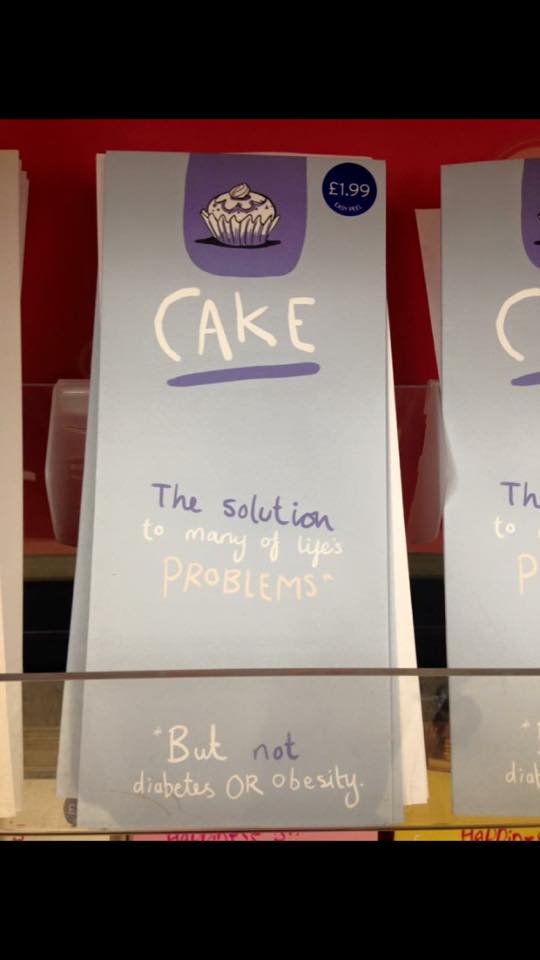
Yesterday I posted about why that card represented all that is wrong with using diabetes as a punch line. Within a matter of hours of a diabetes advocate, Diabetes Power's Angela Allison, posting a picture online of a card she had seen about diabetes and obesity on the shelves of Sainsbury's greeting card section, hundreds of people with diabetes - or those speaking on behalf of someone with diabetes - had launched their complaint with Sainsbury's chief exec, Michael Coupe. 

In a glorious display of the power of social media and a really pissed of bunch of PWDs, Mr Coupe had issued a sincere, warm and humble apology. It went like this: 

"Dear Anna

Thank you for getting in touch.  Firstly let me say how very sorry I am for what has been a lapse in judgment, I completely share your views.

As soon as this was brought to my attention the product was removed from sale across all our stores, and I have this morning asked my team to investigate how this happened.

I pride myself on our values and I do believe our values make us different from other supermarkets, and I know our customers share that view, this is what makes this all the more disappointing.

Thank you again for bringing this to my attention.

Mike"


Hats off to you, Sainsbury's, and thank you for recognising why this card is below the high standards you usually meet. 

Sunday, 14 February 2016

Stigma, diabetes-shaming and that joke about Bob.

I used to find jokes about diabetes funny; especially that one about Bob.  I liked it because it was sarcastic and witty, and there was no conceivable way anyone would think chocolate could cause diabetes.  That's what was funny about it, no?  My favourite blogs were ones which used humour to talk about life with diabetes, and my family and friends shared in-jokes a-plenty about diabetes and the many foibles living with it brings. But then something changed.  

Sometime around my late twenties people stopped asking "What is diabetes?", when the topic inevitably came up as my paraphernalia appeared, and instead people started to ask me questions about what I did to get it, or tell me they had known someone who got rid of it (chortle).  In my late twenties at University came questions from seemingly intelligent friends about whether or not I knew that my 'foot was going to fall off' from eating a chocolate bar (thank you, Scrubs), and then along came MatthewWright-gate when angry online conversations were held about 'diabetes-triggering 'Easter Eggs. Suddenly it wasn't so funny when I realised that people did believe it and that worse still - the hobby of diabetes-shaming had begun.

This year I will reach 30 years of having lived with type 1 diabetes.  I was diagnosed long before the internet, Sky TV and smart phones came about, and if we wanted to learn anything about diabetes we had to look it up in a giant book warehouse called a library (Google it). Since then with the dawn of the technological era, information can literally arrive at your fingertips with the flick of a button, the ping of a news alert or by the dulcet tones of Siri.  And information equals education, right? Sadly, no.

Jamie Oliver: Anti-Diabetes Warrior
When I was young and diabetes was raised in conversation, my clumsy 11 year-old self would try to give the best definition of what I was living with, hoping it might make sense. I hadn't yet thought of Jeff.  But now that people can easily find photos of the loveable Jamie Oliver standing in front of a coke bottle with the word 'diabetes' blamefully written on the side, or shop for tasteless greetings cards at Sainsbury's where diabetes is once again the butt of a joke, it has become publicly acceptable to use diabetes as a punch line.  With the era of accessible information also came the era of misinformation, and the blaming of people with diabetes for their own condition.  Suddenly everybody's an expert, and diabetes is fair-game for ridicule.

I recently took to Social Media to ask Sainsbury's for a conversation about that diabetes card (and also of course to ask where I can pick up a piece from their emphysema range, or if the do an asthma-specific selection), because the joke just isn't funny any longer - not when people struggle to separate truth from ridiculous humour.  I have been accused of lacking a sense of humour and of needing to lighten up, but here's the thing, if teenagers stop being bullied due to the image that 'diabetes' now has, or people with type 2 stop living with constant stigma as a result of me temporarily shelving my sense of humour and arguing the point, so be it.

The fact is the Sainsburys card isn't even particularly offensive. It's tasteless at worst.  But it insinuates and represents everything which is wrong with the way diabetes is treated both in the media and over coffee-table conversations around the world. We've come such a long way in thirty years.  Technologically we are in the most exciting season of diabetes. We are in the Summer of  advances in medical equipment and hope for a 'cure'.  But when it comes to diabetes-shaming and the way in which diabetes is used as comedy canon-fodder, we are firmly mid-Winter. We have learnt nothing in the last three decades. 

The answer is seven; Bob has seven candy bars.

Saturday, 13 February 2016

Spare a Rose: Save a Life.


There are times in life - when my cannula rips out on a kitchen counter, or my Dexcom itches at my skin from lack of air under the over-used tape - that I find myself feeling less than grateful for the medical technology which keeps me alive. When the clumpy pump won't hide under a slinky top, or my Dexcom sensor protrudes from my leg under my skinny jeans like some kind of bodily 'yuck', I find myself frustrated with diabetes and the cyborg 'kit' that comes with it. But the truth is, that 'kit' - that expensive, wicked clever kit - does more than just keep me alive, it helps me live the life that I want; the life I deserve. 

It's hard to imagine, given my fortunate life in a developed country where it is considered wholly unacceptable for any person to have to die from lack of basic necessities like insulin, that there are children and young people in this very world - the one we share with them - who live on a constant perilous precipice.  Why?  Because they don't know whether or not they will have enough insulin to keep them alive today. 

This situation, which millions of children around the world face on a daily basis, is not only unacceptable, it should be impossible.  No child should die because of lack of access to insulin. Every child deserves to live, and not in constant anguish or fear that today may be their last. Every...single...child.

A group called Partnering for Diabetes Change, came together a while back to see how we, the diabetes community and the wider population of the world, can help.  That's when the 'Spare a Rose: Save a Life' campaign was born.

The Spare a Rose campaign invites people around the world to donate the cost of just one rose on Valentine's Day, just £3, to the International Diabetes Federation's Life for a Child programme which provides insulin to those living in developing countries.  That £3 will keep a child alive for a month.  That romantic bunch of roses, will keep a child alive for a year.

Last year $25,579 was raised, from donors in 684 countries, which kept 426 children alive for a year.

On Valentine's Day, why symbolise your love for someone by buying them something which will whither and die within days, when you could declare your love with a gift which will grow and thrive for a year.  Give life.

Thursday, 28 January 2016

Bra shopping and Trainspotting

I've reached the stage in life where my brain is officially full.  Not with useful information or anything which could contribute to a long and happy career, of course.  Quite the contrary; I know nothing of politics, science or history, but ask me the theme tune to 'Captain Planet' circa 1991, or what PSSO means in knitting, and I truly come into my own.  The problem is, due to being full to the brim with theme tunes, lyrics to every Julie Andrews song and the detailed workings of how to make a strawberry smoothie (it's all in the yogurt), in order for new information to enter I have to go through what is officially (not even a little bit officially) called 'brain leakage'.

When I gave birth to the little three months ago, brain leakage of momentous scale took place.  Out went information like how to access my online banking, mathematics and the location of my car keys, and in came how to put on a nappy, the theme tune to Rasta Mouse, and who the hell Macca Pacca is.  As a result of this mass leakage, other key knowledge was lost - like why I had previously always packed spare infusion sets wherever I went.

The thing about people living with diabetes is that we are nothing if not resourceful.

It was shortly after lunch I ripped my cannula out today when a careless trouser waist-band re-adjustment manoeuvre took place.  I was an hour away from home spending a rare few hours with my best friend, buying bras to fit my post-baby body (see also: small refugee family could camp in the cups...).  I was desperate not to go home, but with an abundance of insulin in my possession and no way of administering it, I feared our day together might be coming to the most swift of ends.  Unsure of whether or not I would be successful, we hot-footed it to the local Boots, hoping that our foray into the world of well-fitting bras wasn't the end of our fun today, if we could only secure a hypodermic needle.

I explained my predicament to the pharmacist as she asked me questions about which kind of needle I would need.  Sadly that information was lost in the official (not official) Brain Leakage of 2013, when I got a new job. But between us we managed to establish that 'nothing fancy' would do.

"Would you like one of the drug user kits?" she asked, helpfully.

Slightly taken aback but glad there might be an option, I rummaged through the kits given out free to intravenous drug users in a bid to encourage safer and cleaner ways of using drugs, if they must.  With a veritable Pandora's box of thingameejigees, I eventually came across an individually wrapped  hypodermic needle.

"Perfect!",  I proclaimed as an examination of the needle showed a clear gauge on the side which I could use to draw up insulin to the correct amount.  Sheepishly (but gratefully) I tucked the kit away into my bag, hoping no-one with a knowledge of drug use might see me excitedly fumbling through the kit. 

Luckily, the lady in Boots saved my day, and my diabetes, a great deal of hassle.  On arriving home I was a happy 4.4 mmol, and pleased that I'd found a workaround for not having been prepared. But having learned today that carrying a spare cannula in my bag is absolutely vital, I only dread to think what else has now leaked out of my too-full brain... 

Wednesday, 25 November 2015

Everybody loves Frio!

If you have type 1 diabetes and need to keep insulin cool, then you will undoubtedly have heard of Frio.  When travelling New Zealand at the beginning of the year my Extra Large Frio case became my best friend for keeping my meds in happy holiday mode.

When Frio UK contacted me to ask me to take a look at some new products I was glad to because, frankly, I heart their products.

Here's what I thought!


Check out their shop here.

If you have any questions about their products feel free to drop me an email at anna@insulinindependent.com.

Sunday, 8 November 2015

Lazy Diabetesing / Survival Mode

Two weeks ago we, as a family, welcomed my little girl into our lives. Having seen my unwavering efforts to keep blood sugar hikes and spikes at bay during pregnancy, I was whole-heartedly congratulated on a job well done by my family members (aka, 'the help').  Inside, I congratulated myself too. It was a slog, but I did it.

Throughout pregnancy, my aim was to keep my diabetes as balanced as possible, without becoming a massive control freak and giving birth to one stressed-out neurotic little kiddo. But after 9 months with an HbA1c in the low 6s, healthy squishy bits and a full term pregnancy, it felt like the challenge (war?) had been won. Two weeks on, it has dawned on me that the challenge (war?) is only just starting. 

Immediately after she was born, I smugly looked at my CGM trend thinking how very much I had 'this'. My nice steady line with occasional above 10 mmol spike painted the picture of a mother absolutely nailing post-birth blood sugars. Two weeks on, and even my CGM trend arrow is trying to show me where I went wrong. 

My once 'never away from my side' receiver now shows a sorry trend of gaps and spikes. The gaps telling the story of it having been left in another room, far from anywhere conceivably useful. The spikes sharing its tale of alarms smothered into silence at the bottom of a nappy changing bag - often rummaged around in, but never for the CGM. The weathered tally gear case shows its age, and the precious upper and lower alarm limits set beautifully at 4 and 7.5mmol (target numbers for pregnancy) now stand at 4 and 13mmol, because I had to turn off the alarms which have been the electronic nag in my life since February 2015. The battery uncharged for the third time in this week. A sorry tale it tells. 


Am I lazy diabetesing? Well, no. Right now I'm adjusting to a new normal beyond anything I could have imagined. My kid is amazing, but in a world where only last night Jamie and I celebrated sleeping in the same bed for the first time in two weeks, there is no room for diabetes 'perfection', if there even is such a thing. If there is, it probably holidays with the 'compliant diabetic' and the 'optimal control' gang. 

Right now I'm living day-to-day, in survival mode. And while I thank my situation daily to be able to use a pump and CGM, right now, as I learn tricks of the trade for getting dressed AND having a shower in one day through a fog of sleep deprivation and survival naps, my diabetes has to just tick by on autopilot. My pump means I always have insulin when I leave the house, and my Dexcom is the safetynet of blood sugar mayhem. Anything in between 'way too high' and 'plummeting like fuck' is pretty much OK. 

The time will come when I have the headspace to basal test between breastfeeds, and prepare blood sugar friendly foods between vomitted-on outfit changes. For now, I'll stick with survival mode 

And on we must go. 

Sunday, 1 November 2015

Diabetes and Pregnancy: The End Game

Today is the first day of diabetes awareness month, centering around November 14th, World Diabetes Day.  As the days of the month turn over like pages of a book, social media fills up with information, opinion, blog posts, product launches and events.  For me, November has always been about educating, advocating, empowering and de-stigmatising a condition that affects millions around the world.  This year, it represents that little bit more because today, November 1st, 2015, my little girl turns one week old.

November this year represents both a new chapter in my life entitled 'motherhood', and a new chapter in my diabetes life of being a mother, with diabetes.  As I learn about the fun and foibles of being a mother - of breast-feeding and explosive nappies, of pram construction and bedtime routines (or total lack of them, if my little one week old is anything to go by) - I also now have to do so alongside learning how to manage my diabetes with this new beautiful person in my life - one who needs me to be on my game around the clock.  Learning how to prioritise when a hungry baby demands a feed after I've bolused for my dinner, or how to manage the blood sugar drops of breast-feeding or of remembering to check my blood sugars when my CGM alarms rather than treat the hypo it says I'm having because I'm just too tired from a bad night's sleep.  How will I treat a hypo when baby needs a feed?  And how will I keep my HbA1c from drifting as my focus is pulled in a direction other than my diabetes?  Time only will tell.

This year November and beyond is about learning how to do diabetes all over again.  It is about resilience and re-educating.  It is about finding balance, and about using the technology I have at my disposal to make diabetes a big enough priority in my life that the control and quality of life I enjoy so much aren't sacrificed, without leaving my child thinking diabetes is number one.  It isn't. But in many ways diabetes was easier to manage during pregnancy because it was all I had to do.  If my levels were wacky, a short walk could bring them down swiftly, and appointments were no issue to attend because it was just me to worry about.  Now, there is another person - one who cannot reason or wait -  whom I need to think about first.  

Pregnancy was without a doubt the most challenging period in the time I've had diabetes, made up of equal parts determination, joy, frustration and fear.  But the end result of careful planning, resilience and keeping my eye on the pot of gold at the end of the rainbow was a healthy baby girl, all 7 pounds 11 ounce of her.  Only this pot of gold isn't the stuff of myth, she is very much here.

Happy Diabetes Awareness month people.  Let's make this a good one!